Showing posts with label collection. Show all posts

Wednesday, October 12, 2011

Blast from the Past

One neat thing about working in the Archives is you never know what you'll run across. 

Karen Shephard, a volunteer in the Archives & Collections Department, has been working on organizing and processing a collection of material from Ed Thompson related to the Permian Basin Petroleum Association.  In the material, there was a publication from the Midland Chamber of Commerce, probably dated from 1971, trying to recruit mid-continent oil companies to set up shop in Midland.

Above: Cover of publication.

Above: Aerial view of Midland at time of publication, circa 1971.

One interesting tidbit found in the publication is the statistics about Midland and housing in Midland:


Above: General Information & Housing Costs in Midland circa 1971.

I wonder how that compares to today ...

Thursday, March 10, 2011

Oil in Libya

The Petroleum Museum's Library & Archives Center has been a hive of activity recently. We now have four faithful volunteers in the Center, working on various projects. One volunteer, Ms. Hunt, took on the task of processing a small collection found on the backlog shelves.

Turns out, the collection from Robert Stine, long-time patron of the Museum, dealt with the building of the Trans-Alaskan Pipeline in the 1970s AND the ESSO (now EXXON) oil industry in Libya in the 1960s.

Finding materials about the oil industry in Libya? How timely, considering the current events happening. I knew that Libya was an "oil-rich" nation in northern Africa. But I did not know much about its political or economic history.


Above: Some of the materials included in the Robert Stine Collection (2011-002).

After a little digging (thanks to Wikipedia and the New York Times online), I discovered that Libya was a kingdom prior to 1969. All of the ESSO materials in this particular collection pertaining to Libya date prior to 1969. Turns out, the Libyan kingdom was pro-Western and friendly with Western countries such as the U.K. and the U.S. According to one of the publications ESSO in Libya 1963:
"The Libyan Petroleum Law became effective in June 1955 and Esso Libya applied for, and was granted, nine concession areas covering about 100,000 sq.kms. The company then began the painstaking search for oil."


"Esso was the first:
* To discover oil in Libya
* to build a crude oil pipeline to the sea
* to build a marine terminal
* to produce and export oil to foreign markets
* to build a refinery in the country to produce processed oil products for local consumption
* and among the first to agree to the Petroleum Law Amendments of 1961."


On 1 September 1969, a small group of military officers led by then 27-year-old army officer Muammar Gaddafi staged a coup d'état against King Idris, launching the Libyan Revolution. After the coup, Gaddafi closed American and British bases and partially nationalized foreign oil and commercial interests in Libya.

An interesting story ...

Monday, December 13, 2010

Finding the Frame Family

The upcoming holidays and the usual end-of-the-year festivities always remind me of family. Whether you like them or not, your family shapes who you are. Your ancestors contributed to who you are today. And your great-grandchildren will be influenced by the choices you make today.

With this in mind, I turned to the topic of “family” for this post. Upon researching early families in the Permian Basin, I came across the Frame family.

The Museum’s Library & Archives Center has several photographs of members of this family. In fact, some of them grace the Museum’s photograph murals in the North Wing. However, our records for those photographs do not provide much, if any, substantial information about the family; I knew James Milton Frame worked in Odessa and Monahans for the Texas & Pacific Railway in the early twentieth century. And he had several brothers and a father in the area.

With such little information, I turned to the Museum’s Reference Library. With over 2000 published titles, many of which are out of print, the Library holds a wealth of information on Permian Basin county histories. Sure enough, several Odessa and Ector County books held photographs and brief captions on the Frame family. Yet, it was not until I turned to Ward County, 1887-1977, published by the Ward County Historical Commission, that I found more details. Apparently, Paul Frame, James Milton’s son, provided recollections and reflections about his family for the tome’s comprehensive history.

Mr. and Mrs. S. Frame had four sons: James Milton, Walter L., Jesse L., and Charles Albert. One was a newspaper editor, one was an agent for the Texas & Pacific Railway, and two were telegraph operators. I’m sure Father Frame never realized the parts his sons would play in the shaping of the Permian Basin!

An expert telegrapher, Walter L. Frame or “Sport” came to West Texas from Kimbolton, Ohio, in 1888 to work as a night telegrapher for the Texas & Pacific Railway. “Sport” brought his brother James Milton to Monahans in 1889 and taught him telegraphy.

James Milton, in turn, worked as a telegraph operator in Midland for several years in the 1890s. (He worked in numerous places, including Metz, Allamore, Odessa, and Pecos, over his twenty-seven years with the Texas & Pacific Railway.) While in Metz, James met Catherine Andrews and they married in Midland in 1895. By 1896, he was the depot agent as well as the postmaster in Monahans. As postmaster, he devised a progressive method to sort the mail: he used “pigeon holes” for the patrons’ mail and could lock the whole thing while away. Together, James and Catherine had three children, daughter Thelma (born 1897), son Paul (born 1900) and son James Eugene (born 1903). After working for the Texas & Pacific, James Milton Frame worked an additional twenty-one years for the El Paso and Southwestern Railway, eventually retiring in 1938 to Ruidoso, New Mexico.

Jesse L. Frame was the newspaper man. In 1906, he helped J. H. Rotramel launch the Ector County Democrat. They were assisted by Charles Judkins and Miss Gertie Rabb. Miss Annie Mae Harkey set type by hand for the paper. Jesse owned and operated the newspaper until 1911.

Charles Albert, the fourth brother, was a long-time telegraph operator in Odessa and in Monahans. Charles married Georgia Hogg from Odessa. He was also elected to the first City Council as an alderman for Monahans in 1928. He passed away in 1960 at the age of 77.


James (sitting) and Walter Frame, circa 1890. At the time of this photograph, James was the night telegraph operator for the Texas & Pacific Railway in Midland, Texas. (From the Paul Frame Collection, 84-016.008.)


Old Section House in Metz, Texas, circa 1893. James and Walter Frame stand on the gallery. By this time, James was the station agent in Metz. (From the Betty Orbeck Collection, 76-094.055)


Interior of the Ector County Democrat office, circa 1906. Jesse L. Frame (standing on the left) owned and edited the paper until 1911. (From the Betty Orbeck Collection, 76-094.060)


Charles, Jesse and James M. Frame at the Monahans Texas & Pacific Railway Depot, circa 1909. Jesse sits on a copy press in the center with Charles to the left and James to the right. By this time, James was the station agent. (From the Paul Frame Collection, 84-016.014)


Interior of James M. Frame’s home in Monahans, Texas, circa 1910. (From the Betty Orbeck Collection, 76-094.153)


Interior of Monahans Texas & Pacific Railway Depot, circa 1910. Standing left to right: James M. Frame, agent; Pink Mitchell, rancher; Cleve Brown; Theo Andrews, roadmaster (at telephone). Sitting left to right: Charles Frame, 2nd trip operator, and S. Frame, father of James M. and Charles. (From the Abell-Hanger Foundation Collection, 76-093.470)


If any information is incorrect or if you have additional information, please contact me by leaving a comment!

Wednesday, November 17, 2010

Collection Management Policies

Wednesday afternoon, the Museum's Board of Trustees voted to approve the Collection Management Policy I developed for this institution.

This kind of document is very important to any museum and its collection.

According to The New Museum Registration Methods:
Policies for managing collections provide the framework for decisions that determine the long-term development, care, and management of an institution's collections.


John Simmons writes in his article "Managing Things - Crafting a Collections Policy" from the January/February 2004 edition of MuseumNews:
The collections management policy is the institutional policy that governs everything a museum does to care for and grow its collections and make them available to the public.


And Marie Malaro, in A Legal Primer on Managing Museum Collections, states:
A collection management policy is a detailed written statement that explains why a museum is in operation and how it goes about its business. The policy articulates the museum's professional standards regarding objects left in its care and serves as a guide for the staff and as a source of information for the public.


In other words, the Collection Management Policy (or CMP for short) guides the museum, and in turn its staff, in acquiring, caring for, and (possibly) deaccessioning its collections. It is a hefty document, covering a wide range of topics, from the scope of collections and ethics to acquiring and disposing objects, from providing access to objects (whether by loans or exhibits) to care and maintenance of those objects. By its very nature, the policy is a living document, which needs to be regularly and routinely revised and approved by a governing authority.

From the CMP, an institution can develop a Collection Plan (i.e. long-term plan on what to collect) and procedures on how to do specific tasks. For the last two years, I have been steadily forming the policies and procedures for the Archives & Collections Department here at The Petroleum Museum. However, those documents are only as good as the foundational framework that the CMP provides.

Wednesday, November 3, 2010

Accessions

Back in July, I posted about how The Petroleum Museum relies on donors' generosity in building our collections.

So what happens after a donor has offered an object to the Museum and it has been accepted? As with many things in the museum-world, there is a process from offer to acceptance to accession. According to The New Museum Registration Methods, accessioning is the act of recording or processing an addition to the permanent collection.

Offers come in all forms: over the phone, in person, via email or regular mail, etc. As I mentioned in my Donor Generosity post, each offer is considered and weighed in light of the Museum's collection needs as well as the Museum's mission, among other criteria.

Once an offer is accepted, first thing I do is write a Gift Acknowledgement letter and Deed of Gift and send it off to the donor. Depending on the object, I may also include an Object History Form to obtain more information for our records. The key is to collect as much information as possible about the donor and the gift. It's this information that gives the object its value!


Above: Deed of Gift for the Statue of Liberty. Document with watercolor, July 4, 1884. Courtesy of the National Archives and Records Administration, Washington, D.C. (44) Needless to say, The Petroleum Museum's Deed of Gifts are not watercolored.

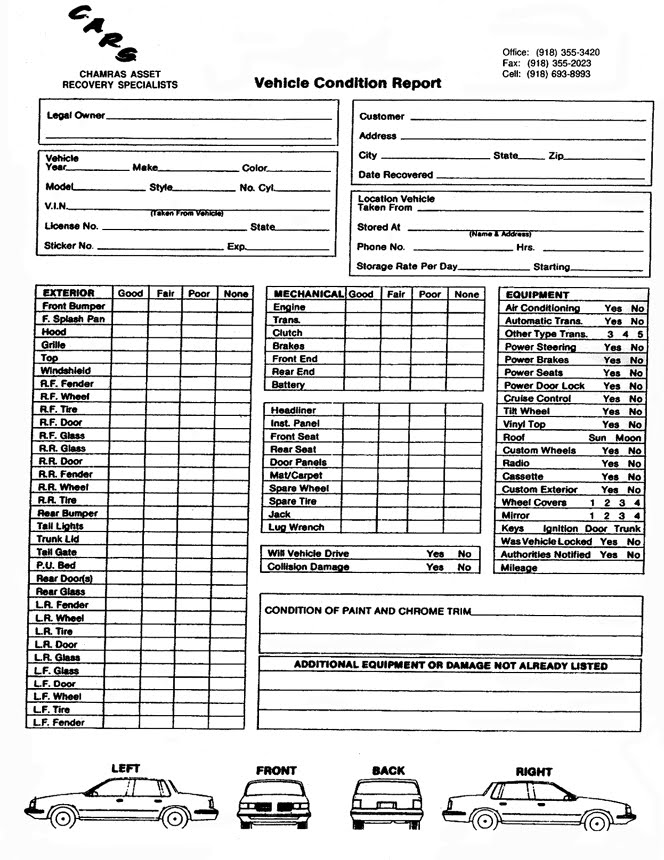
Once the Deed of Gift is back in hand, I can fully process and catalogue the object. I use several forms to do so: Accession Checklist, Catalog Sheet, and Condition Report. I also take photos of the object for the file and the database.


Above: Condition Report for cars. A museum's Condition Report is similar.

I can then house the object appropriately. For instance, if the object is a framed painting, I will hang it in the Vault, our framed art storage area. If the gift consists of photographs, I will house them in plastic sleeves and in our photographic cabinets. Sometimes, objects will go directly on display. However, most objects will stay in storage until they are needed for programs or exhibits.

Tuesday, August 31, 2010

Puzzle Pieces

Several months ago, Fifi, the Museum's Gift Shop Manager, brought two prints down to my office. She said, "These were given to the Museum when Kathy and Cheryl [former Education Director] attended a conference in 2005."


Print #1: Derricks, After the Rain


Print #2: Evening Brea Canyon

"Gee, thanks. That helps a lot," I thought sarcastically. I set them aside to deal with later.

Fast forward several months and I reach a stopping point in my cataloguing project last week. So I turn my focus on the above-mentioned prints. Taking a close look at the prints, I realize they are signed by the artist JoAnn Cowans.

So I google her ... Sure enough, she has a website. And after a few clicks, I find the two prints on there. "Okay," I think. "This is the right artist." Then I click on her email address and write the following missive:

My name is Leslie Meyer and I am currently the Director of Archives & Collections at The Petroleum Museum. We have come across two prints of your paintings in our collections and have no idea who gave them to us. One is “Derricks, After the Rain” and the other is “Evening Brea Canyon”; both numbered #21 out of 400. They both have Certificates of Authenticity attached as well. I’ve attached photographs of each.

I am hoping you can help me. Do you keep records as to which numbers go to whom? If so, do you know who originally obtained these prints? I’m trying to track down who gave these lovely prints to the Museum.


The next day, JoAnn Cowan herself calls me to discuss this message. During our conversation, she indicates that I should contact Bruce Wells, Executive Director of the American Oil & Gas History Society. You see, JoAnn donated several prints to him to hand out as gifts. Ms. Cowan assures me that she would reach out to him about this.

After I didn't hear anything further, I decide to reach out to Bruce Wells myself. I find his email address online and write the following yesterday:

I am hoping you can help me with a puzzle.

I got your name from Jo Ann Cowans regarding two prints of her artwork that the Museum currently has in its possession. From what I understand, the two prints, “Derricks, After the Rain” and “Evening Brea Canyon”, were given to Kathy Shannon, Executive Director, and a fellow colleague while attending a conference in 2005 or so. Both are numbered #21 out of 400 and signed by the artist; and they both have Certificates of Authenticity attached. (Images of both are attached to this email.)

I contacted Ms. Cowans asking if she maintained records on who received which numbers of the limited prints. When she called me, she mentioned that you had obtained several prints of her artwork to hand out as gifts. Would you happen to be the donor of these two prints to The Petroleum Museum? If so, I would need you to complete a Deed of Gift and other necessary paperwork to finalize the transaction. If not, would you happen to know who might be?


And, sure enough, he calls me today. Mr. Wells confirms that he did indeed give those two prints to Kathy and Cheryl while they were attending an oil education conference in Wichita, Kansas, in 2005. What luck!

I absolutely LOVE these kinds of puzzles ... from a seemingly dead-end, I follow the trail to the end! From two prints given 5 years ago, I now have a donor. The Deed of Gift is already in the mail!

Thursday, July 1, 2010

Donor Generosity


Lately, it seems people are coming out of the woodwork to offer items to the Museum. In the past week, I've gotten calls, emails and in-person visits from people all over the country offering objects ranging from scrapbooks to posters to drilling rigs.

Museums, like The Petroleum Museum, strive on the generosity and thoughtfulness of people like that. While cataloguing the permanent and archival collections, I've quickly realized that The Petroleum Museum would not be the kind of institution it is without the generosity of donors from all over the country. These donors were often repeat-offenders, offering items of all types frequently over several years.

However, not everything can, or even should, be accepted into a museum's collection. If it did, then the collection would be quite large and undefined. A museum is defined by its relationship with its collections, starting with the accumulation and acquisition of things. However, acquisition of objects for the collections should be done carefully and thoughtfully. According to Marie C. Malaro, in her book A Legal Primer on Managing Museum Collections:

Without clear direction, poor decisions are bound to be made, and for a museum, many such "mistakes" have no easy solutions. The best approach is prevention, and today an almost essential preventive measure is the adoption and implementation of a collection management policy.


A Collection Management Policy offers guidelines regarding various aspects from acquisition and accession to security and storage to deaccession. (I've posted about security and deaccesion already.)

Here at The Petroleum Museum, our Collection Management Policy outlines the criteria on which we can accept (or conversely deny) a donation. Any object considered for acquisition will only be accepted if it meets the following criteria:.
* The object must be relevant to the Museum’s mission, purpose and collection scope.
* The object has historical or scientific merit and/or has historical or cultural significance.
* No object shall be acquired for the collections if the Museum cannot give it proper storage, protection and preservation.
* The Museum will not knowingly accept any object acquired by either illegal or unethical means.
* Unless there is a compelling reason to do otherwise, the Museum will only accept unrestricted gifts for acquisition wherein free and clear title shall be obtained without restriction as to use or future disposition.
* The Museum should seek to secure copyright license on all acquisitions.
* The Museum will not acquire redundant copies or duplicate objects or collections unless it is deemed necessary by the Board of Trustees.


We at The Petroleum Museum try to be careful and thoughtful in what we do accept into the Museum's collections. The main questions we ask ourselves are: (1) Does this support our mission to share the petroleum and energy story of the Permian Basin? Is the object relevant to the Permian Basin? (2) Does this duplicate other objects in our collection? (3) Does the object have historical, technical and/or cultural significance? Does the object support a story we have to tell through our exhibits?

We truly do appreciate all the offered donations. However, several factors, including those listed above, play into our decision-making process.

If you would like to learn more, feel free to leave a comment. Or check out the above books. Marie Malaro's A Legal Primer is a must have for any museum or museum professional. She touches on every legal aspect related to a museum's collection. John E. Simmons' Things Great and Small is a textbook on Collection Management Policies and a must-have for anyone who needs to draft one. Click on the image to go to Amazon listing of each book.

Friday, June 25, 2010

Stolen Goods

A couple of days ago, I received an email from a grad school friend, Heather Hope Stephens. (You can read her museum-related blog here. She offers an interesting mixture of legal insight and museum mentality with her posts. I encourage you to check it out!)

The email was essentially a link to the following article. The British Guardian article highlights what could be a serious lack of security at London's cultural institutions during the upcoming 2012 Summer Olympics. The reporter recollects an earlier incident:
During the 1994 winter Olympics in Norway, thieves stole Edvard Munch's painting The Scream from the Oslo National Art Museum and left a note that said: "Thanks for the poor security."

After reading the article, I am shocked that security might not be a priority at these institutions during such a world-wide event. Makes one wonder what "criminal attacks" are happening in South Africa during the World Cup.

Security is a serious issue for museums and other public institutions. Yes, museums are intended for the public. People from the community are encouraged to come inside (or outside) and tour the various spaces to view the numerous objects on display and read the text associated with those objects. In recent years, museums have increasingly become centers for the community.

Yet, museums must maintain security to protect those numerous objects both on display and in storage while keeping visitors safe. Prohibiting visitors from touching and handling objects allow those items to be kept for a long time so that visitors in the future may enjoy them. Also, state and federal laws regarding accessibility (e.g. ADA) regulate building structure as well as exhibit design to a certain extent. So that everyone may enjoy the museum, security deterrents should be low-key but effective. It's a delicate balancing act.

Here at The Petroleum Museum, we have several security deterrents in place. From stanchions to alarms, some work better than others to dissuade visitors from getting too close. Hopefully, though, they do not hinder visitors' enjoyment of their museum-going experience.

What do you think? Leave a comment!
Tuesday, June 22, 2010

Modern Marvels

For me, Saturday mornings tend to be relaxing. I may or may not dust and vaccuum and I may or may not watch television. This past Saturday, however, I decided to flip through the channels and happened across the History Channel's Modern Marvels.

I was instantly engrossed with the episode. Instead of investigating food processing or other technology, this particular episode was about the Library of Congress, "The Real National Treasure." The description of the episode says it all:

Where in Washington D.C. is the nation's most incredible treasure chest? It's a library unlike any other in the world--the U.S. Library of Congress. Explode the myth that this 200-year-old institution is simply "where members of Congress borrow books." Viewers are taken beyond the magnificent Jefferson Building Great Hall into the secret vaults where more than 600 miles of shelves hold 130 million items, many of them priceless treasures--from George Washington's hand-written diaries to Galileo's first images of the moon to the original camera film of the movie Frankenstein. See how a staff of 4,000 catalogues protects and preserves these treasures and distributes them globally via a new World Digital Library.

The Library of Congress (LoC) has a HUGE collection containing millions of objects which are individually catalogued, researched and housed. I was slightly jealous (okay, REALLY jealous) of the resources available to the LoC. The govermentally funded institution has thousands of collection specialists, cataloguers, preservation specialists, and copyright specialists on staff. Not to mention the storage facilities available to the growing collection! If only every museum, library and archives had those kinds of resources on hand ...

If you are flipping through television channels, and happen upon this episode, pull up a seat and enjoy the ride. It's not to be missed!

Thursday, June 10, 2010

The Ole Switcheroo ... Sort Of

So, you may notice that it's not Friday. In fact it's Thursday ... almost a week AFTER the Friday mentioned in my previous post. Short story is that I misspoke -- I really should confirm everything before I say (or write) things like that on this blog. I hope you will forgive me.

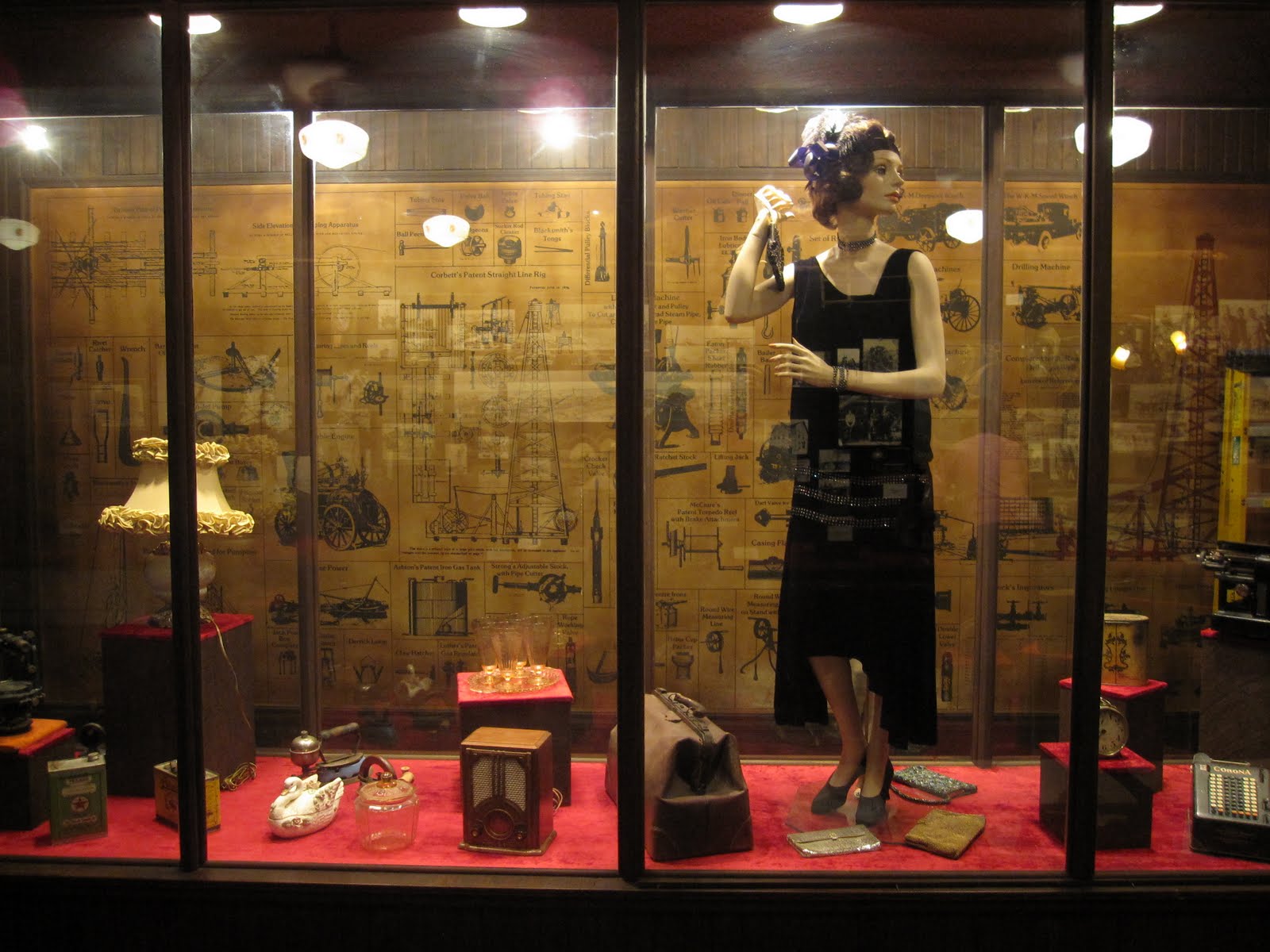
Swtiching out the dresses in the Memorabilia Room in the East Wing was postponed to this past Wednesday. I needed Edward to open the case (which only opens on one narrow side) and I recruited Michelle to help since Whitney was gone all week. Little did I know that the change of plans was an omen of things to come ...

On loan to the Museum since 2002, the wedding dress with shoes belongs to Kathy Shannon, Executive Director, and was worn by her grandmother. Kathy's oldest daughter, recently engaged, wants to wear her great-grandmother's shoes. Kathy asked if I could switch out the dresses in the case and return the wedding dress and shoes. Looking into my records, I discovered that those dresses had been on display since 2002 when Kathy loaned the wedding dress and the black dress was donated to the Museum. Eight years is a little long for clothing to be on display. It was certainly time to switch out dresses!


After removing the glass panel of the case and some of the objects, Edward and Michelle work on removing the mannequin with the wedding dress.


I undress the mannequin. I remove the hat and veil and then I remove the shoes (size 5 1/4!). Michelle and I managed to remove the mannequin arms so that the dress slipped over the head.

I had selected two dresses from the Permanent Collection to replace the wedding dress and black flapper dress.


I unpack the navy organza and satin dress with rust trim.


I attempt to dress the mannequin.

Despite valiant efforts by Michelle and I, we were unable to dress the mannequin. The mannequin was too big for the dress. Plus, the fabric was so fragile that there were rips and tears throughout. The navy dress was not in good condition for display.


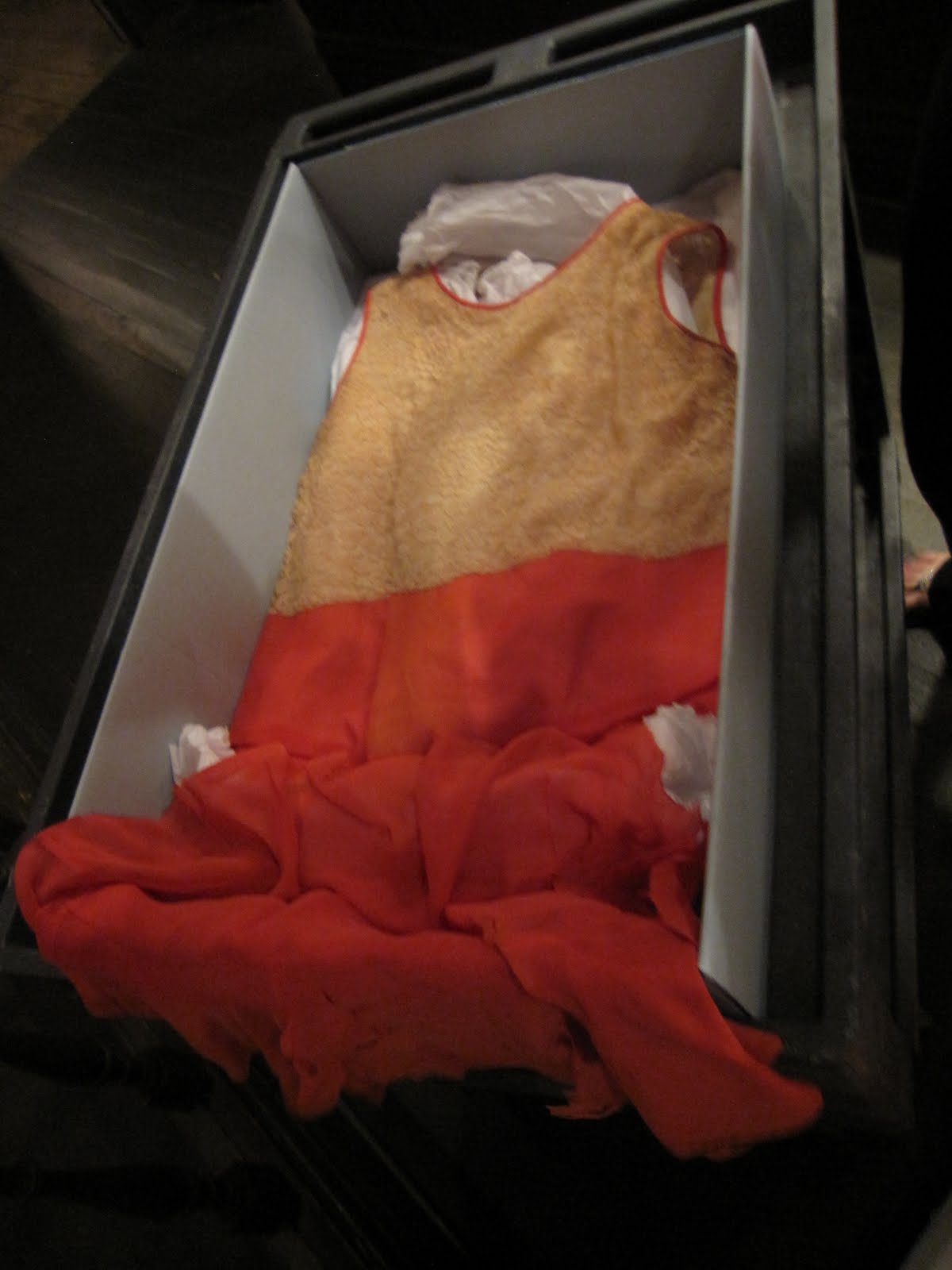
I decided to take a look at the red georgette dress. It too was in poor condition.


The dress and jacket are made of georgette. The fabric now is very fragile and torn in places. Notice the white spot on the jacket -- that's a hole.


I look at my list to see of potential replacements.

So what to do? We can't put a naked (pronounced nak-id) mannequin back in the case. And I didn't think I had anything else in the Permanent Collection in good enough condition to be on display.

Our solution? Keep the black flapper dress. Rearrange objects within the case and from the room to fill in the case. Because of the nature of the display case (mainly, one opening at a narrow end), I ended up being a contortionist. The following shots are of me maneuvering the case, moving objects and being a little silly.


"Look at me, I'm a mannequin."


Moving objects so that the case is balanced and aesthetically pleasing.


The final result.

STAY TUNED (this time for real): Tomorrow, I'll show you how I packed the wedding dress. If you want to "heirloom" your own wedding dress, follow these simple steps!

Thursday, May 20, 2010

Deaccessions

At yesterday's meeting, the Board of Trustees approved to deaccession objects from the Museum's Permanent Collection and transfer them to the National Ranching Heritage Center (NRHC) at Texas Tech University.

While doing some "Spring Cleaning," I came across a file that contained a Loan Agreement, completed by my predecessor in April 2006, loaning several pieces of oil field equipment to the NRHC. I contacted both the NRHC and my predecessor who confirmed that the materials were to be deaccessioned and then given to the NRHC; however, the process was never completed.

What is deaccession, you ask? According to the Museum Registration "bible" (The New Museum Registration Methods, edited by Rebecca Buck and Jean Allman Gilmore), deaccession is the formal change in recorded status of the object. Where accessioning is the process by which objects come into the Museum's collection, deaccessioning is the opposite of that. Once objects are deaccessioned, then they can go through a disposal process.

One should not see deaccessioning as a bad thing or even as controversial. Yes, museums are to preserve and build collections for prosperity. However, museums are living things -- missions, policies and people change which changes the institutions themselves. Objects once thought critical to a museum's mission may no longer be so after time. Or objects may be duplicated multiple times in a museum's collection and other institutions could use those items for their own collections.

According to the Museum's Collection Management Policy, items can be deaccessioned for a number of reasons, such as:
The object is no longer within the Museum’s scope or mission.
The object does not support the collecting policy of the Museum.
The object does not have clear, legal title.
The object does not support the research, education or exhibition purposes of the Museum.
The object unnecessarily duplicates other objects in the Museum’s collections.
The object requires storage or conservation resources that cannot be provided by the Museum.
The object was accessioned in error, such as tools, exhibit cases, exhibit material or cleaning supplies.
The object is a danger and hazard to museum staff, volunteers, and patrons.

The items approved for deaccessioning yesterday were all duplicates in the Museum's Permanent Collection; they are much better utilized at the NRHC.

Questions? Leave a comment!

Thursday, May 6, 2010

Emergency

Monday afternoon I was cataloguing some photographs when my boss, Kathy Shannon, the Executive Director, came into my office. "Leslie, I need to talk to you," she said while walking toward object storage in the Pit.

Remember what the Pit looked like?


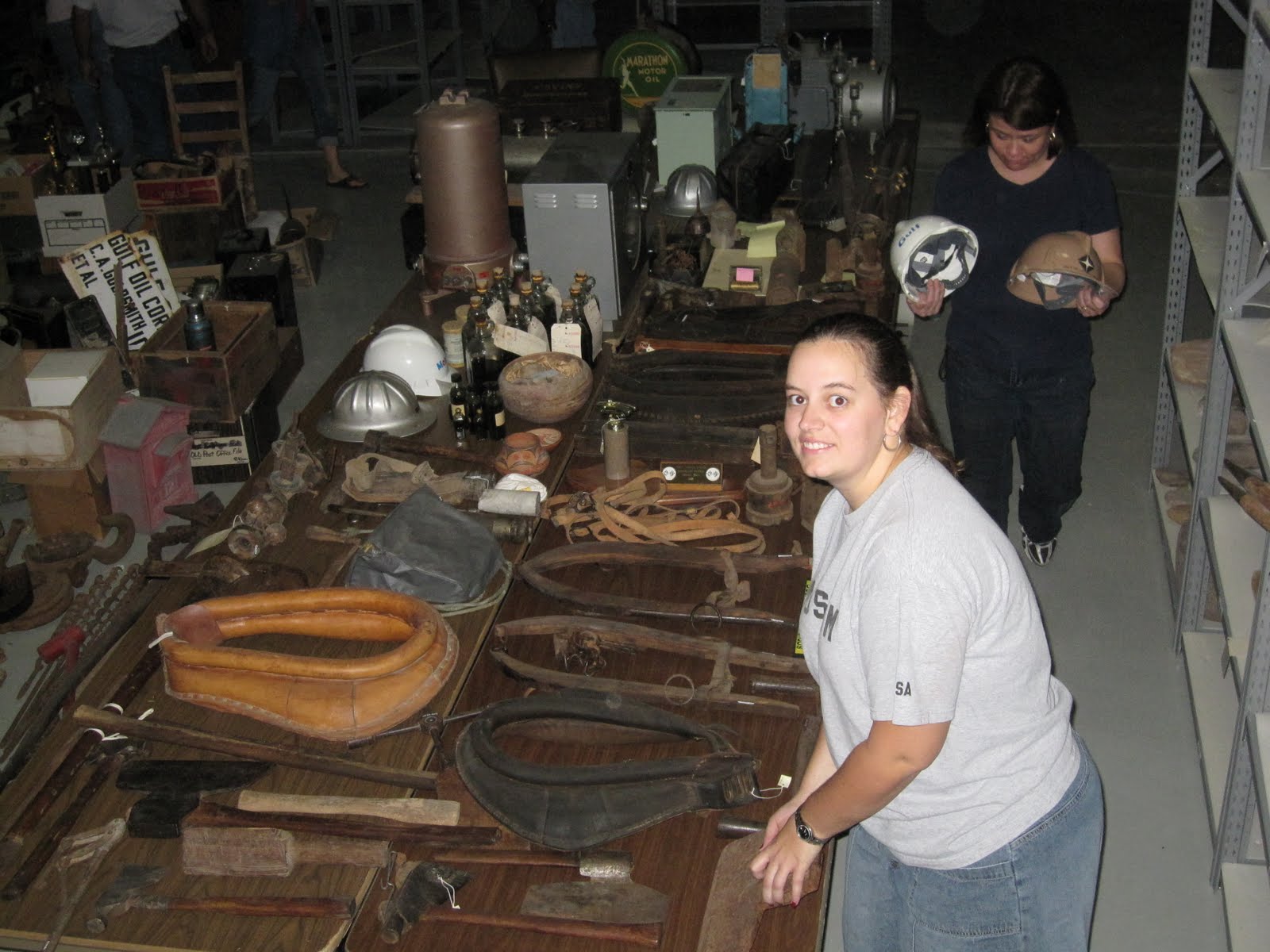
The Pit houses oil field tools and equipment as well as cultural and historical objects (formerly on display in the West Wing) on a series of metal bookshelves. Also in the Pit was maintenance equipment and defunct exhibit materials. Cleaning out the Pit and moving object storage to another location has been on my list of "To Do" since I started here.

Kathy took me into the Pit that afternoon and told me that the collection objects were being threatened.

Above those bookshelves, you see, is a large piece of canvas which hangs between object storage and the pipeline airplane exhibit in the North Wing above.

The painted backdrop, backed by masonite, behind the airplane had slipped its anchors and was presumably resting precariously against non-load bearing walls.


Needless to say, this news was a shock to me. Should the backdrop fall forward, it would hit the plane. Should the backdrop fall backward, it would crush the exhibit wall behind it, possibly hitting some collection objects in that area. Should the backdrop continue to slide, the canvas floor/celing might cave in on top of the collection objects below in the Pit. None of those scenarios were good.

So, Kathy and I developed a plan: Spend Tuesday cleaning out the maintenance and exhibit materials. Use Wednesday to move the collection away from the canvas ceiling and underneath the concrete one.

Tuesday, I helped the Facilities Supervisor and his assistant clear out some wooden shelves. In the afternoon, Lauren and Whitney showed up to help. We continued to clean -- removing trash, setting aside collection objects, and sweeping. By the end of the afternoon, we were in a good place to start moving boxes and objects.


And no, it's not snowing in the Pit. That's the reflections off the dust in the air after moving, cleaning, and sweeping!

Wednesday morning, most of the Museum's staff helped shuttle boxes of collection boxes to the wooden shelves. We then moved the loose objects to tables. When we ran out of space there, we laid some on foam on the floor and even moved some shelving units to under the concrete for more storage!


Many hands made light work -- we were done in about an hour!

Now, you may see many issues in the images above: wooden shelves, objects on the floor, no gloves, etc. As this was an emergency situation, I was mainly concerned about getting the objects out of immediate harm's way. Most of those objects, such as the oil field tools and equipment, have seen worse conditions than what they are currently under. In the next few weeks, I hope to move those objects to a more permanent storage home in the Museum.