I cannot believe the first month of 2011 has come and gone already! Things have been seemingly low-key at the Museum this month.
One major accomplishment for January: I completed my major project of creating an accession register for the archvies & library donations since 1965. It's nice to know what the Museum actually has! Not only did I create an electronic register (thanks to Excel), I also added most gift/donation information to our collection management database Re:Discovery. With time, and practice, every piece in our collections should be searchable in the database! That will allow us to better serve researchers, visitors and just interested people! Next step? Conducting an inventory to match up actual items (objects, books, manuscripts, etc) with the information. Wish me luck!
Now I can also turn my attention to the Train to Share project I've discussed multiple times here. We are finally ready to start uploading the digital objects and their associated metadata! Hopefully the team will be able to upload our 1000 objects!
Lately, I've also been very busy with researchers and other visitors looking for photographs. In fact, one Friday (typically a quiet day for the Archives Center) I had three appointments and a conference call scheduled. I had to schedule another researcher for the next week because I was so busy! It's great that the Library & Archives Center has had such a demand!
February will be a busy month for the Museum. On the 17th, we'll host our third Family Science Night of the [academic] year: Inventions! Come to the Museum between 6:30 and 8:00 p.m. to learn and explore well-known and not-so-well-known inventions. Lemonade and cookies are provided! Then, a couple of days later, the Museum will host Read-A-Rama on Saturday, the 19th. Come explore the wonderful world of reading and literacy!
Friday, February 4, 2011

Monday, December 13, 2010
Finding the Frame Family
The upcoming holidays and the usual end-of-the-year festivities always remind me of family. Whether you like them or not, your family shapes who you are. Your ancestors contributed to who you are today. And your great-grandchildren will be influenced by the choices you make today.
With this in mind, I turned to the topic of “family” for this post. Upon researching early families in the Permian Basin, I came across the Frame family.
The Museum’s Library & Archives Center has several photographs of members of this family. In fact, some of them grace the Museum’s photograph murals in the North Wing. However, our records for those photographs do not provide much, if any, substantial information about the family; I knew James Milton Frame worked in Odessa and Monahans for the Texas & Pacific Railway in the early twentieth century. And he had several brothers and a father in the area.
With such little information, I turned to the Museum’s Reference Library. With over 2000 published titles, many of which are out of print, the Library holds a wealth of information on Permian Basin county histories. Sure enough, several Odessa and Ector County books held photographs and brief captions on the Frame family. Yet, it was not until I turned to Ward County, 1887-1977, published by the Ward County Historical Commission, that I found more details. Apparently, Paul Frame, James Milton’s son, provided recollections and reflections about his family for the tome’s comprehensive history.
Mr. and Mrs. S. Frame had four sons: James Milton, Walter L., Jesse L., and Charles Albert. One was a newspaper editor, one was an agent for the Texas & Pacific Railway, and two were telegraph operators. I’m sure Father Frame never realized the parts his sons would play in the shaping of the Permian Basin!
An expert telegrapher, Walter L. Frame or “Sport” came to West Texas from Kimbolton, Ohio, in 1888 to work as a night telegrapher for the Texas & Pacific Railway. “Sport” brought his brother James Milton to Monahans in 1889 and taught him telegraphy.
James Milton, in turn, worked as a telegraph operator in Midland for several years in the 1890s. (He worked in numerous places, including Metz, Allamore, Odessa, and Pecos, over his twenty-seven years with the Texas & Pacific Railway.) While in Metz, James met Catherine Andrews and they married in Midland in 1895. By 1896, he was the depot agent as well as the postmaster in Monahans. As postmaster, he devised a progressive method to sort the mail: he used “pigeon holes” for the patrons’ mail and could lock the whole thing while away. Together, James and Catherine had three children, daughter Thelma (born 1897), son Paul (born 1900) and son James Eugene (born 1903). After working for the Texas & Pacific, James Milton Frame worked an additional twenty-one years for the El Paso and Southwestern Railway, eventually retiring in 1938 to Ruidoso, New Mexico.
Jesse L. Frame was the newspaper man. In 1906, he helped J. H. Rotramel launch the Ector County Democrat. They were assisted by Charles Judkins and Miss Gertie Rabb. Miss Annie Mae Harkey set type by hand for the paper. Jesse owned and operated the newspaper until 1911.
Charles Albert, the fourth brother, was a long-time telegraph operator in Odessa and in Monahans. Charles married Georgia Hogg from Odessa. He was also elected to the first City Council as an alderman for Monahans in 1928. He passed away in 1960 at the age of 77.


If any information is incorrect or if you have additional information, please contact me by leaving a comment!
With this in mind, I turned to the topic of “family” for this post. Upon researching early families in the Permian Basin, I came across the Frame family.
The Museum’s Library & Archives Center has several photographs of members of this family. In fact, some of them grace the Museum’s photograph murals in the North Wing. However, our records for those photographs do not provide much, if any, substantial information about the family; I knew James Milton Frame worked in Odessa and Monahans for the Texas & Pacific Railway in the early twentieth century. And he had several brothers and a father in the area.
With such little information, I turned to the Museum’s Reference Library. With over 2000 published titles, many of which are out of print, the Library holds a wealth of information on Permian Basin county histories. Sure enough, several Odessa and Ector County books held photographs and brief captions on the Frame family. Yet, it was not until I turned to Ward County, 1887-1977, published by the Ward County Historical Commission, that I found more details. Apparently, Paul Frame, James Milton’s son, provided recollections and reflections about his family for the tome’s comprehensive history.
Mr. and Mrs. S. Frame had four sons: James Milton, Walter L., Jesse L., and Charles Albert. One was a newspaper editor, one was an agent for the Texas & Pacific Railway, and two were telegraph operators. I’m sure Father Frame never realized the parts his sons would play in the shaping of the Permian Basin!
An expert telegrapher, Walter L. Frame or “Sport” came to West Texas from Kimbolton, Ohio, in 1888 to work as a night telegrapher for the Texas & Pacific Railway. “Sport” brought his brother James Milton to Monahans in 1889 and taught him telegraphy.
James Milton, in turn, worked as a telegraph operator in Midland for several years in the 1890s. (He worked in numerous places, including Metz, Allamore, Odessa, and Pecos, over his twenty-seven years with the Texas & Pacific Railway.) While in Metz, James met Catherine Andrews and they married in Midland in 1895. By 1896, he was the depot agent as well as the postmaster in Monahans. As postmaster, he devised a progressive method to sort the mail: he used “pigeon holes” for the patrons’ mail and could lock the whole thing while away. Together, James and Catherine had three children, daughter Thelma (born 1897), son Paul (born 1900) and son James Eugene (born 1903). After working for the Texas & Pacific, James Milton Frame worked an additional twenty-one years for the El Paso and Southwestern Railway, eventually retiring in 1938 to Ruidoso, New Mexico.
Jesse L. Frame was the newspaper man. In 1906, he helped J. H. Rotramel launch the Ector County Democrat. They were assisted by Charles Judkins and Miss Gertie Rabb. Miss Annie Mae Harkey set type by hand for the paper. Jesse owned and operated the newspaper until 1911.
Charles Albert, the fourth brother, was a long-time telegraph operator in Odessa and in Monahans. Charles married Georgia Hogg from Odessa. He was also elected to the first City Council as an alderman for Monahans in 1928. He passed away in 1960 at the age of 77.

James (sitting) and Walter Frame, circa 1890. At the time of this photograph, James was the night telegraph operator for the Texas & Pacific Railway in Midland, Texas. (From the Paul Frame Collection, 84-016.008.)

Old Section House in Metz, Texas, circa 1893. James and Walter Frame stand on the gallery. By this time, James was the station agent in Metz. (From the Betty Orbeck Collection, 76-094.055)

Interior of the Ector County Democrat office, circa 1906. Jesse L. Frame (standing on the left) owned and edited the paper until 1911. (From the Betty Orbeck Collection, 76-094.060)

Charles, Jesse and James M. Frame at the Monahans Texas & Pacific Railway Depot, circa 1909. Jesse sits on a copy press in the center with Charles to the left and James to the right. By this time, James was the station agent. (From the Paul Frame Collection, 84-016.014)

Interior of James M. Frame’s home in Monahans, Texas, circa 1910. (From the Betty Orbeck Collection, 76-094.153)

Interior of Monahans Texas & Pacific Railway Depot, circa 1910. Standing left to right: James M. Frame, agent; Pink Mitchell, rancher; Cleve Brown; Theo Andrews, roadmaster (at telephone). Sitting left to right: Charles Frame, 2nd trip operator, and S. Frame, father of James M. and Charles. (From the Abell-Hanger Foundation Collection, 76-093.470)
If any information is incorrect or if you have additional information, please contact me by leaving a comment!
Wednesday, November 24, 2010
Preserving Photographs
With the holidays, particularly Thanksgiving, right around the corner, I cannot help but think of family and tradition at this time of year. Until the New Year, I hope to make posts around this theme. This is just the first of the series.
I came across this post from the Smithsonian Visual Archives blog called "The Bigger Picture" which is updated regularly with images, links and snipets of history. In the post, Nora Lockshin, Paper Conservator at the Smithsonian Institute, describes her mother's project to preserve photographs, those pictorial documents of memories.
Photographs are sensitive objects, especially the older they are, which include daguerreotypes, tintypes, albumen prints, and silver gelatin prints. Typically, the image (created by a variety of materials depending on the kind of print) is suspended in a transparent binder layer (which in turn is made from a choice of materials depending on the process). The image and the binder are both, but individually, sensitive to its environment and each may react differently to it.
Thus, the process to create photographs has changed and developed over time. When photography first became popular in the U.S. in the mid-nineteenth century, daguerreotypes required a light-sensitive silver-plated sheet of copper to be exposed to light and developed over mercury vapor. Nowadays, most photography is digital which requires a whole other set of concerns.
What's important is to know your materials. There is quite a bit of resources out there to aid in preserving photographs. My favorite is Photographs: Archival Care and Management by Mary Lynn Ritzenthaler and Diane Vogt-O'Connor, which appears to be out of print. Check your local public library or museum to see if they have a copy you can review.
I came across this post from the Smithsonian Visual Archives blog called "The Bigger Picture" which is updated regularly with images, links and snipets of history. In the post, Nora Lockshin, Paper Conservator at the Smithsonian Institute, describes her mother's project to preserve photographs, those pictorial documents of memories.
Photographs are sensitive objects, especially the older they are, which include daguerreotypes, tintypes, albumen prints, and silver gelatin prints. Typically, the image (created by a variety of materials depending on the kind of print) is suspended in a transparent binder layer (which in turn is made from a choice of materials depending on the process). The image and the binder are both, but individually, sensitive to its environment and each may react differently to it.
Thus, the process to create photographs has changed and developed over time. When photography first became popular in the U.S. in the mid-nineteenth century, daguerreotypes required a light-sensitive silver-plated sheet of copper to be exposed to light and developed over mercury vapor. Nowadays, most photography is digital which requires a whole other set of concerns.
What's important is to know your materials. There is quite a bit of resources out there to aid in preserving photographs. My favorite is Photographs: Archival Care and Management by Mary Lynn Ritzenthaler and Diane Vogt-O'Connor, which appears to be out of print. Check your local public library or museum to see if they have a copy you can review.
Wednesday, November 17, 2010
Collection Management Policies
Wednesday afternoon, the Museum's Board of Trustees voted to approve the Collection Management Policy I developed for this institution.
This kind of document is very important to any museum and its collection.
According to The New Museum Registration Methods:
John Simmons writes in his article "Managing Things - Crafting a Collections Policy" from the January/February 2004 edition of MuseumNews:
And Marie Malaro, in A Legal Primer on Managing Museum Collections, states:
In other words, the Collection Management Policy (or CMP for short) guides the museum, and in turn its staff, in acquiring, caring for, and (possibly) deaccessioning its collections. It is a hefty document, covering a wide range of topics, from the scope of collections and ethics to acquiring and disposing objects, from providing access to objects (whether by loans or exhibits) to care and maintenance of those objects. By its very nature, the policy is a living document, which needs to be regularly and routinely revised and approved by a governing authority.
From the CMP, an institution can develop a Collection Plan (i.e. long-term plan on what to collect) and procedures on how to do specific tasks. For the last two years, I have been steadily forming the policies and procedures for the Archives & Collections Department here at The Petroleum Museum. However, those documents are only as good as the foundational framework that the CMP provides.
This kind of document is very important to any museum and its collection.
According to The New Museum Registration Methods:
Policies for managing collections provide the framework for decisions that determine the long-term development, care, and management of an institution's collections.
John Simmons writes in his article "Managing Things - Crafting a Collections Policy" from the January/February 2004 edition of MuseumNews:
The collections management policy is the institutional policy that governs everything a museum does to care for and grow its collections and make them available to the public.
And Marie Malaro, in A Legal Primer on Managing Museum Collections, states:
A collection management policy is a detailed written statement that explains why a museum is in operation and how it goes about its business. The policy articulates the museum's professional standards regarding objects left in its care and serves as a guide for the staff and as a source of information for the public.
In other words, the Collection Management Policy (or CMP for short) guides the museum, and in turn its staff, in acquiring, caring for, and (possibly) deaccessioning its collections. It is a hefty document, covering a wide range of topics, from the scope of collections and ethics to acquiring and disposing objects, from providing access to objects (whether by loans or exhibits) to care and maintenance of those objects. By its very nature, the policy is a living document, which needs to be regularly and routinely revised and approved by a governing authority.
From the CMP, an institution can develop a Collection Plan (i.e. long-term plan on what to collect) and procedures on how to do specific tasks. For the last two years, I have been steadily forming the policies and procedures for the Archives & Collections Department here at The Petroleum Museum. However, those documents are only as good as the foundational framework that the CMP provides.
Wednesday, November 3, 2010
Accessions
Back in July, I posted about how The Petroleum Museum relies on donors' generosity in building our collections.
So what happens after a donor has offered an object to the Museum and it has been accepted? As with many things in the museum-world, there is a process from offer to acceptance to accession. According to The New Museum Registration Methods, accessioning is the act of recording or processing an addition to the permanent collection.
Offers come in all forms: over the phone, in person, via email or regular mail, etc. As I mentioned in my Donor Generosity post, each offer is considered and weighed in light of the Museum's collection needs as well as the Museum's mission, among other criteria.
Once an offer is accepted, first thing I do is write a Gift Acknowledgement letter and Deed of Gift and send it off to the donor. Depending on the object, I may also include an Object History Form to obtain more information for our records. The key is to collect as much information as possible about the donor and the gift. It's this information that gives the object its value!

Above: Deed of Gift for the Statue of Liberty. Document with watercolor, July 4, 1884. Courtesy of the National Archives and Records Administration, Washington, D.C. (44) Needless to say, The Petroleum Museum's Deed of Gifts are not watercolored.
Once the Deed of Gift is back in hand, I can fully process and catalogue the object. I use several forms to do so: Accession Checklist, Catalog Sheet, and Condition Report. I also take photos of the object for the file and the database.

Above: Condition Report for cars. A museum's Condition Report is similar.
I can then house the object appropriately. For instance, if the object is a framed painting, I will hang it in the Vault, our framed art storage area. If the gift consists of photographs, I will house them in plastic sleeves and in our photographic cabinets. Sometimes, objects will go directly on display. However, most objects will stay in storage until they are needed for programs or exhibits.
So what happens after a donor has offered an object to the Museum and it has been accepted? As with many things in the museum-world, there is a process from offer to acceptance to accession. According to The New Museum Registration Methods, accessioning is the act of recording or processing an addition to the permanent collection.
Offers come in all forms: over the phone, in person, via email or regular mail, etc. As I mentioned in my Donor Generosity post, each offer is considered and weighed in light of the Museum's collection needs as well as the Museum's mission, among other criteria.
Once an offer is accepted, first thing I do is write a Gift Acknowledgement letter and Deed of Gift and send it off to the donor. Depending on the object, I may also include an Object History Form to obtain more information for our records. The key is to collect as much information as possible about the donor and the gift. It's this information that gives the object its value!

Above: Deed of Gift for the Statue of Liberty. Document with watercolor, July 4, 1884. Courtesy of the National Archives and Records Administration, Washington, D.C. (44) Needless to say, The Petroleum Museum's Deed of Gifts are not watercolored.
Once the Deed of Gift is back in hand, I can fully process and catalogue the object. I use several forms to do so: Accession Checklist, Catalog Sheet, and Condition Report. I also take photos of the object for the file and the database.
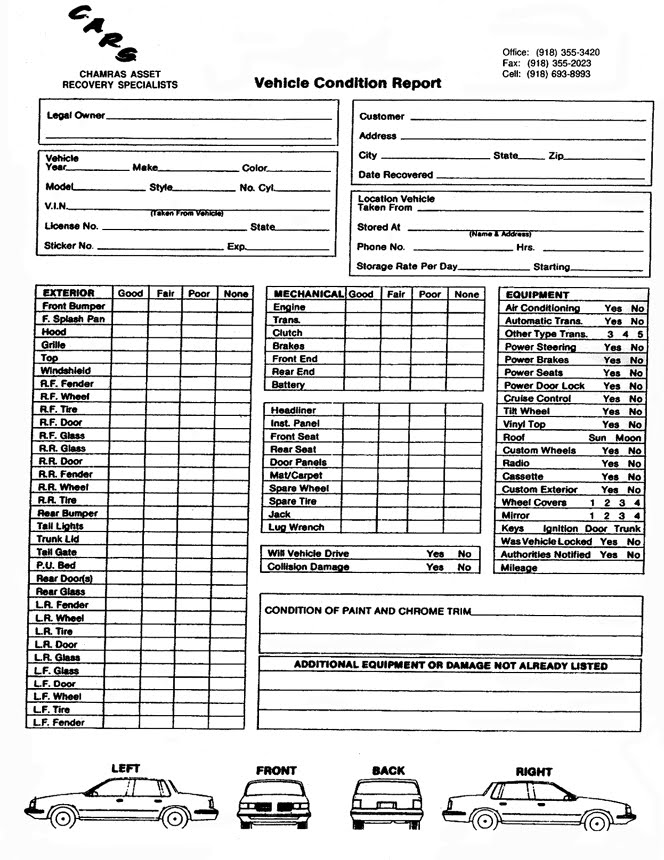
Above: Condition Report for cars. A museum's Condition Report is similar.
I can then house the object appropriately. For instance, if the object is a framed painting, I will hang it in the Vault, our framed art storage area. If the gift consists of photographs, I will house them in plastic sleeves and in our photographic cabinets. Sometimes, objects will go directly on display. However, most objects will stay in storage until they are needed for programs or exhibits.
Wednesday, October 20, 2010
Social Media
Social Media and Web 2.0 have been gaining a lot of momentum in recent years. While I was not (and still am not) an early adopter, I either have used or do use a variety of Web 2.0 tools, such as Facebook, Flickr, Blogger, and Twitter. For instance, I'm not a regular on Twitter but I do follow quite a number of museums to know what's going on.
These tools are perfect for non-profit organizations to use and to disseminate information about their activities and other events. In fact, The Junior League of Midland, Inc. is launching its own Facebook Fan page in order to announce and advertise upcoming community projects and fundraising events.
Yesterday, I registered for a series of webinars sponsored by IMLS (Institute of Museum and Library Services) Connecting to Collections. One of the first sessions is called "Using Social Media to Tell Your Collection's Stories." Colleen Dilenschneider, one of the presenters, posted on her blog about museums and social media. Check it out here.
What is your favorite social media or Web 2.0 tool? How could a museum benefit from its use? Do you connect with any museum through social media?
Or is it weird that I'm using a Web 2.0 technology to discuss social media?
These tools are perfect for non-profit organizations to use and to disseminate information about their activities and other events. In fact, The Junior League of Midland, Inc. is launching its own Facebook Fan page in order to announce and advertise upcoming community projects and fundraising events.
Yesterday, I registered for a series of webinars sponsored by IMLS (Institute of Museum and Library Services) Connecting to Collections. One of the first sessions is called "Using Social Media to Tell Your Collection's Stories." Colleen Dilenschneider, one of the presenters, posted on her blog about museums and social media. Check it out here.
What is your favorite social media or Web 2.0 tool? How could a museum benefit from its use? Do you connect with any museum through social media?
Or is it weird that I'm using a Web 2.0 technology to discuss social media?
Monday, October 18, 2010
Digital Preservation Management
Last week I was in Austin for a two-day workshop on Digital Preservation Management.
I know what you're thinking ... "But aren't you really concerned with preserving 3D objects?" The short answer is yes and no. Yes, my role here at The Petroleum Museum mostly deals with the 3D objects in the Permanent Collection, as well as the 2D objects (documents, manuscripts, photographs) in the Archives and the books and periodicals in the Library.
However, with this Train to Share grant project well underway, I am increasingly concerned with the digital files created from scanning our photographs. How does an organization deal with all these digital "objects" and their relevant information? The Digital Preservation Management (DPM) workshop attempted to answer that question among others.
The biggest take-away for me from the workshop is the image of the three-legged stool. Digital Preservation relies on three elements equally: technology, organization, and resources; it cannot stand on a single leg.
 If any leg is underdeveloped, or overdeveloped, and the stool is whobbly, digital preservation will not last for the long-term. DPM is something one has to carefully plan and invest in.
While The Petroleum Museum is not quite ready for long-term digital preservation, we are on our way, especially thanks to the Train to Share project. The worksthop provided tools so that our institution could invest fully in digital preservation in the future.
I know what you're thinking ... "But aren't you really concerned with preserving 3D objects?" The short answer is yes and no. Yes, my role here at The Petroleum Museum mostly deals with the 3D objects in the Permanent Collection, as well as the 2D objects (documents, manuscripts, photographs) in the Archives and the books and periodicals in the Library.
However, with this Train to Share grant project well underway, I am increasingly concerned with the digital files created from scanning our photographs. How does an organization deal with all these digital "objects" and their relevant information? The Digital Preservation Management (DPM) workshop attempted to answer that question among others.
The biggest take-away for me from the workshop is the image of the three-legged stool. Digital Preservation relies on three elements equally: technology, organization, and resources; it cannot stand on a single leg.
 If any leg is underdeveloped, or overdeveloped, and the stool is whobbly, digital preservation will not last for the long-term. DPM is something one has to carefully plan and invest in.
While The Petroleum Museum is not quite ready for long-term digital preservation, we are on our way, especially thanks to the Train to Share project. The worksthop provided tools so that our institution could invest fully in digital preservation in the future.
Subscribe to:
Posts (Atom)