Thursday, May 20, 2010

Deaccessions

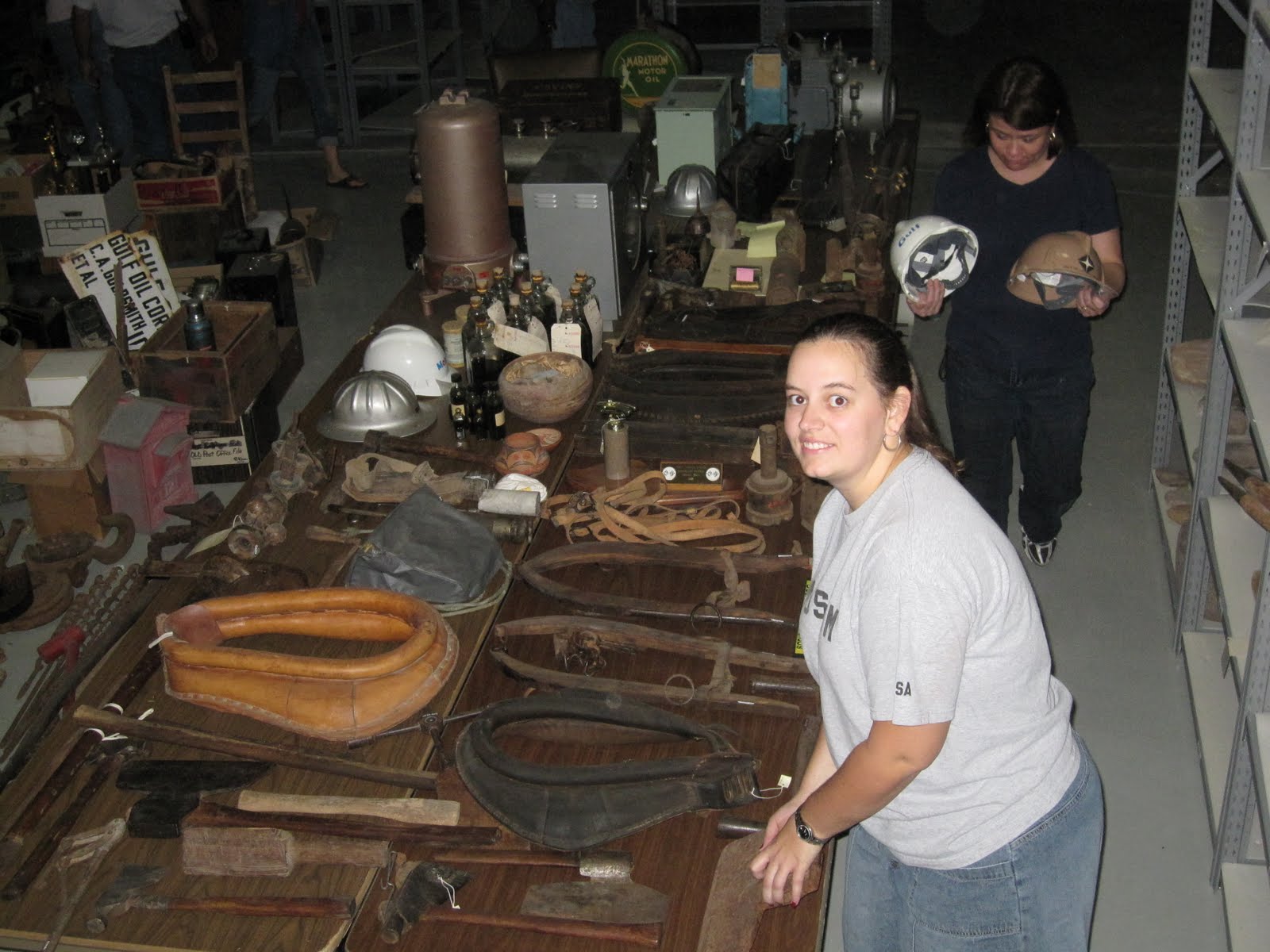
At yesterday's meeting, the Board of Trustees approved to deaccession objects from the Museum's Permanent Collection and transfer them to the National Ranching Heritage Center (NRHC) at Texas Tech University.

While doing some "Spring Cleaning," I came across a file that contained a Loan Agreement, completed by my predecessor in April 2006, loaning several pieces of oil field equipment to the NRHC. I contacted both the NRHC and my predecessor who confirmed that the materials were to be deaccessioned and then given to the NRHC; however, the process was never completed.

What is deaccession, you ask? According to the Museum Registration "bible" (The New Museum Registration Methods, edited by Rebecca Buck and Jean Allman Gilmore), deaccession is the formal change in recorded status of the object. Where accessioning is the process by which objects come into the Museum's collection, deaccessioning is the opposite of that. Once objects are deaccessioned, then they can go through a disposal process.

One should not see deaccessioning as a bad thing or even as controversial. Yes, museums are to preserve and build collections for prosperity. However, museums are living things -- missions, policies and people change which changes the institutions themselves. Objects once thought critical to a museum's mission may no longer be so after time. Or objects may be duplicated multiple times in a museum's collection and other institutions could use those items for their own collections.

According to the Museum's Collection Management Policy, items can be deaccessioned for a number of reasons, such as:
The object is no longer within the Museum’s scope or mission.
The object does not support the collecting policy of the Museum.
The object does not have clear, legal title.
The object does not support the research, education or exhibition purposes of the Museum.
The object unnecessarily duplicates other objects in the Museum’s collections.
The object requires storage or conservation resources that cannot be provided by the Museum.
The object was accessioned in error, such as tools, exhibit cases, exhibit material or cleaning supplies.
The object is a danger and hazard to museum staff, volunteers, and patrons.

The items approved for deaccessioning yesterday were all duplicates in the Museum's Permanent Collection; they are much better utilized at the NRHC.

Questions? Leave a comment!

Wednesday, May 12, 2010

Do you know ...

the story behind this photo?


For the past few days, I've been busy cataloguing our large photographic collection and came across this image today. Written on the back of the print is "Texon, Texas, Reagan County ca. 1926 - 1932 Texon Harmonica Band."

Whenever I come across an old image of people, particularly children, I have to stop and really look. I start to wonder about the people in the picture: Who are/were they? What were they like? What did think or do or believed? What do/would they think of now?

The image above brought up the same questions. Who were these kids, in their uniforms and hats, and shiny harmonicas? The two boys in the front hold a trophy. Did the group win a tournament? Who were the women on either side, also in their uniforms and hat, and the man in his pressed suit?

Does anyone know anything about this group? I would love to hear from you! Leave a comment or contact me at the Museum (432-683-4403).

Friday, May 7, 2010

Goodbye and Good Luck!

Today was Lauren's last day. I've mentioned Lauren in some of my previous posts. She was hired as the Archives Assistant two months after I came on board at The Petroleum Museum.

She has been my right-hand for almost a year and a half, helping with exhibits programming. She has also worked on the seemingly huge undertaking of scanning the Photographic Collection as well as making a dent in the backlog archival materials. Words fail to describe how she will be missed.


Lauren has decided to persue her photography career full-time. We wish her the best in that endeavor! Check out her website here. She even has a blog too!

Good luck, Lauren!

Thursday, May 6, 2010

Emergency

Monday afternoon I was cataloguing some photographs when my boss, Kathy Shannon, the Executive Director, came into my office. "Leslie, I need to talk to you," she said while walking toward object storage in the Pit.

Remember what the Pit looked like?


The Pit houses oil field tools and equipment as well as cultural and historical objects (formerly on display in the West Wing) on a series of metal bookshelves. Also in the Pit was maintenance equipment and defunct exhibit materials. Cleaning out the Pit and moving object storage to another location has been on my list of "To Do" since I started here.

Kathy took me into the Pit that afternoon and told me that the collection objects were being threatened.

Above those bookshelves, you see, is a large piece of canvas which hangs between object storage and the pipeline airplane exhibit in the North Wing above.

The painted backdrop, backed by masonite, behind the airplane had slipped its anchors and was presumably resting precariously against non-load bearing walls.


Needless to say, this news was a shock to me. Should the backdrop fall forward, it would hit the plane. Should the backdrop fall backward, it would crush the exhibit wall behind it, possibly hitting some collection objects in that area. Should the backdrop continue to slide, the canvas floor/celing might cave in on top of the collection objects below in the Pit. None of those scenarios were good.

So, Kathy and I developed a plan: Spend Tuesday cleaning out the maintenance and exhibit materials. Use Wednesday to move the collection away from the canvas ceiling and underneath the concrete one.

Tuesday, I helped the Facilities Supervisor and his assistant clear out some wooden shelves. In the afternoon, Lauren and Whitney showed up to help. We continued to clean -- removing trash, setting aside collection objects, and sweeping. By the end of the afternoon, we were in a good place to start moving boxes and objects.


And no, it's not snowing in the Pit. That's the reflections off the dust in the air after moving, cleaning, and sweeping!

Wednesday morning, most of the Museum's staff helped shuttle boxes of collection boxes to the wooden shelves. We then moved the loose objects to tables. When we ran out of space there, we laid some on foam on the floor and even moved some shelving units to under the concrete for more storage!


Many hands made light work -- we were done in about an hour!

Now, you may see many issues in the images above: wooden shelves, objects on the floor, no gloves, etc. As this was an emergency situation, I was mainly concerned about getting the objects out of immediate harm's way. Most of those objects, such as the oil field tools and equipment, have seen worse conditions than what they are currently under. In the next few weeks, I hope to move those objects to a more permanent storage home in the Museum.

Monday, April 26, 2010

Digitization

As promised, I bring you the second half of my TLA Digitization Expo presentation, already in progress ...

Shortly after I started at The Petroleum Museum, the Development Director Luanne Thornton forwarded an email to me with an invitation to apply to the Rescuing Texas History grant. UNT's Portal to Texas History would offer mini-grants (ranging from $25 to $2500) to organizations with at-risk local history materials. According to the email announcement:
This project promises immeasurable benefit to cultural heritage institutions by preserving at-risk historical materials. These items are in danger of being lost forever, but with the generous support of the Summerlee Foundation, UNT proposes a solution that will help prevent damage from continued handling, while making these valuable historical materials widely accessible to all Texans.

I have previously mentioned the Portal to Texas History on this blog here.

Through this grant, the Museum received enough funding to digitize 368 images (with UNT responsible for metadata). We sent several small collections of photographic prints and negatives from the Museum's Library & Archives Center, all dealing with Texas from the late 1890s through the 1950s. Peruse the Museum's collection of images at UNT's Portal to Texas History here under the Recent Additions tab.

The purpose of the Portal to Texas History is to make materials available to the public, from academic university researchers to report-writing fourth graders to the amateur history enthusiast. This, in turn, is the purpose of museums, libraries and archives. These organizations are here for the public's benefit.

Soon after receiving the Rescuing Texas History grant, the Museum was recruited to participate in the Train to Share grant program, a project administered by the Texas State Library and Archives Commission. Learn more about the project here.

The Petroleum Museum has partnered with the Confederate Reunion Grounds in Mexia, Texas, and the Southwest Collection/Special Collections Library at Texas Tech University in Lubbock, Texas. As a state-wide team, we will attend a series of 5 workshops to learn how to plan, create and complete a digitization project. Then we'll digitize and make accessible 1000 digital objects. Our project title is "Earth, Wind, and Fire: Texas Energy Resources." The grant covers workshop expenses plus $3000 (over the 3-year timeframe) per team. (I actually just returned from the fourth workshop, Principles of Controlled Vocabulary and Theasurus Design, in Lubbock, Texas.)

This partnership has allowed even further collaboration. You see, the online module of The Petroleum Museum's collection managment database was cost prohibitive. So, the Museum has signed a Memo of Understanding with Texas Tech. The University will provide storage and access to their online module (DSpace) while the Museum will enter data and create the digital objects.

With the fifth workshop around the corner, things are getting in gear to get the project off the ground. As of now, I have identified three small photographic collections to include in the project. Those images have been catalogued and scanned. I will be trained on how to use DSpace in June. After training, I'll start posting those images online. Also, with the grant monies, I plan to purchase a network server for the Library & Archives Center for image storage and database access.

So that encompasses the digitization efforts at The Petroleum Museum. I am very excited about sharing images from the Museum's collections with the public online. Leave a comment to share what you think!

Friday, April 16, 2010

Accomplishments

Last Wednesday afternoon I found myself at the Henry B. Gonzalez Convention Center in San Antonio in front of a group of library professionals talking about the digitization efforts at The Petroleum Museum. I was at the Texas Library Association's Digitization Expo. For more information about the annual conference, check out the TLA website. I had made the 5+ hour drive (through rain!) from Midland to San Antonio to talk about my experience with the Train to Share project, couched within the context of my other digitization activities at the Museum.

The presentation "Tales from the Trenches" began with an overview of the Museum itself and what I, and Lauren, have accomplished in such a short time. I wanted to share that information with you today.

As Director of Archives & Collections, I am responsible for the Museum's Library & Archives Center ...


Top: Entrance to the Museum's Library & Archives Center
Bottom: Processed Archives Storage


... as well as the permanent collection.


Top: Object Storage in The Vault
Bottom: Object Storage in The Pit


Soon after I started at the Museum, I realized that we needed to get intellectual control over all of the collections. I began with an inventory of the Library - with over 2000 published titles and periodicals, some of which are out of print!

Above: The Reading Room

Lauren came on board soon after I did and started working on the backlog of archival collections. Even though it may not look it, she has certainly made a dent!

Above: Archival Storage

Once the Library was inventoried, I began working on cataloguing the permanent collection into the Museum's collection management database. The database had been, until then, primarily used for the Library Holdings and Archival Collection, but was underused for the Permanent Collection. Over the course of several months, we entered over 3000 object records into the database. While doing so, I also rehoused the object files in acid-free, archival folders, labeling them consistently.

Above: Archives & Library Object Files (what the Museum Object Files looked like)

Above: Museum Object Files after Cataloguing and Rehousing

Now, Lauren and I are working on cataloguing and scanning our large photographic collection. (Estimates for this collection range from 250,000 to 400,000 images.) The photographic prints and negatives in the collection reflect the history and culture of the Permian Basin and includes images of the ranching heritage of the area as well as the petroleum industry. This collection is a wonderful asset to the Museum!


Top: Photograph Print Storage
Bottom: Negative Storage for Rubin Collection


Lauren works on scanning the images, in line with standards we have in place, while I catalogue each image into the database.


Above: Lauren scans a photograph.

Even though Lauren and I have accomplished so much in such a short amount of time, there is still a lot to do! Next week, I'll post about the Train to Share project we are working on.

Wednesday, April 7, 2010

Curiosity Cabinets

Mark your calendars now! May 13th is the next Family Science Night at the Petroleum Museum. From 6:30 to 8:00 p.m., hundreds of children will learn about "ologies" of Science.

I will even man a table there about museology -- or the study of museums -- focusing on curiosity cabinets or “Kunst und Wunder-kammer” (literally 'art and wonder rooms'). These rooms of curiosities reflect the times in which they flourished.


Above: Frans Francken the Younger, Art and Curiosity Collection, early 17th century. Kunsthistorisches Museum, Viena.

The Renaissance saw the world expand -- Europeans travelled to the far off lands of Asia, Africa and the Americas, bringing back things no one had ever seen before. These items, whether shells, animals or clothing, became collector items, just like comic books or baseball cards today.


Above: Taken from Lorenzo Legati, Museo Cospiano, 1677. Marchese Ferdinando Cospi (1606-1686) gave his collection to the city of Bologna in 1657 for the use of scholars.

Collectors then stored these items in cabinets or even entire rooms, organizing them in different ways, from artificial versus natural to place of origin to four elements (earth, air, water, fire). Collectors would often publish guides outlining their methods too.


Above: Etching of Ole Worm's Museum. Taken from Ole Worm (1588-1654), Museum Wormianum; seu, Historia rerum rariorum, tam naturalium, quam artificialium, tam domesticarum, quam exoticarum . . . , 1655.

Head over to The Petroleum Museum on Thursday, May 13th to learn more!