April 10 through 16 is National Volunteer Week. The Library & Archives Center has some great and dedicated volunteers. This is the second in a series of posts about the volunteers here.
Meet Mrs. Karen Shephard.
(Photo to follow. Karen is out of town so I am not able to get a photo of her!)
Karen Shephard is a new addition to the Libray & Archives Center, starting last November after being recruited by Karen Lowder, a dedicated Santa Rita Club member (and future SRC President). Karen S. has been processing the more difficult back-log archival collections and has been doing a fabulous job! She is currently working on a medium-sized collection of records related to the Permian Basin Petroleum Association from Ed Thompson.
Karen grew up in upstate New York but moved around the United States as part of the Air Force. She has a background in accounting, having worked for several oil & gas business in the Permian Basin, including Exxon, ARCO, Duke Energy and Pure Resources. Her husband Rick and she enjoy going to the theater (I often see them at Midland Community Theater). Karen also enjoys reading, crochet, puzzles and music. We've become fast colleagues and friends!
Thursday, April 14, 2011

Monday, April 11, 2011
National Volunteer Week: Morris Bassham
April 10 through 16 is National Volunteer Week. The Library & Archives Center has some great and dedicated volunteers. This is the first in a series of posts about the volunteers here.
 Meet Mr. Morris Bassham.
Mr. Bassham has been a dedicated volunteer in the Archives Center since October 2008. He has been cataloguing our large photograph collection; he reviews the card catalogue and completes worksheets for each image. (This process creates a hard copy of the catalogue information to include with the object file.) Periodically, I review his work and add it to the growing collection management database.
Personally, Mr. Bassham has an interesting background. Having grown up in Midland, attending Midland High School, Morris became a petroleum engineer with Sinclair Oil & Gas from which he retired when they merged with ARCO. Not only did he attend Texas Tech University, Mr. Bassham also attended art school in Minneapolis and Sul Ross University. He also spent twenty-one months in the military and became active with the Confederate Air Force for twenty-five years, although he is no longer a pilot. His interest in the military does not end there: he is interested in aviation history, from the Wright Brothers to the Enola Gay, as well as the history of the Alamo and the State of Texas.
Morris is also an active volunteer within the community, having devoted time to the research library at the Commemorative Air Force.
 Meet Mr. Morris Bassham.
Mr. Bassham has been a dedicated volunteer in the Archives Center since October 2008. He has been cataloguing our large photograph collection; he reviews the card catalogue and completes worksheets for each image. (This process creates a hard copy of the catalogue information to include with the object file.) Periodically, I review his work and add it to the growing collection management database.
Personally, Mr. Bassham has an interesting background. Having grown up in Midland, attending Midland High School, Morris became a petroleum engineer with Sinclair Oil & Gas from which he retired when they merged with ARCO. Not only did he attend Texas Tech University, Mr. Bassham also attended art school in Minneapolis and Sul Ross University. He also spent twenty-one months in the military and became active with the Confederate Air Force for twenty-five years, although he is no longer a pilot. His interest in the military does not end there: he is interested in aviation history, from the Wright Brothers to the Enola Gay, as well as the history of the Alamo and the State of Texas.
Morris is also an active volunteer within the community, having devoted time to the research library at the Commemorative Air Force.
Thursday, April 7, 2011
Busy, Busy, Busy
The past month has gone by in a blur!
The Museum is preparing for our fundraiser, the 2011 Hall of Fame gala. This year we are honoring I. Jon Brumley, Dr. Sam Gibbs, William Kleine and the team of Mack Chase and John R. Gray. Invitations are out, thanks to some great and dedicated staff members and volunteers! The event is next Thursday night. Do you have your seat reserved?
The last week of March, I went to Austin for the Outcome Based Evaluation of the Train to Share grant program which I have participated in for the past several years. Team members from all over Texas congregated to discuss individual and organizational successes (and not-so-successes) for the grant as well as offer some reflection and insight into the program itself, with suggestions for the future.
That week also saw the installation of the new exhibit in the Davidson Gallery: Extra Virgin Petrus Oil by Mery Codigna Collet, a Venezuelan artist who uses petroleum and its by-products to highlight serious concerns. Her method is fascinating: she paints on pieces of plastic, then layers them facing the canvas. The result, in my opinion, is a high-gloss painting with depth. You must see them in person! Mery had a successful gallery talk and opening last Tuesday.
Tomorrow, the Archives Center will be undergoing some changes too. With the Train to Share grant, we have been able to purchase a networked server dedicated to the Museum's Library & Archives Center. The server will house the various files and digital objects (photographs) as well as the collection management database which all will be accessed from the computers in the Center.
Among those activities, we have been fielding requests for photographs and research materials. We are definitely staying busy! Of course, May is shaping up to be a busy month too....
The Museum is preparing for our fundraiser, the 2011 Hall of Fame gala. This year we are honoring I. Jon Brumley, Dr. Sam Gibbs, William Kleine and the team of Mack Chase and John R. Gray. Invitations are out, thanks to some great and dedicated staff members and volunteers! The event is next Thursday night. Do you have your seat reserved?
The last week of March, I went to Austin for the Outcome Based Evaluation of the Train to Share grant program which I have participated in for the past several years. Team members from all over Texas congregated to discuss individual and organizational successes (and not-so-successes) for the grant as well as offer some reflection and insight into the program itself, with suggestions for the future.
That week also saw the installation of the new exhibit in the Davidson Gallery: Extra Virgin Petrus Oil by Mery Codigna Collet, a Venezuelan artist who uses petroleum and its by-products to highlight serious concerns. Her method is fascinating: she paints on pieces of plastic, then layers them facing the canvas. The result, in my opinion, is a high-gloss painting with depth. You must see them in person! Mery had a successful gallery talk and opening last Tuesday.
Tomorrow, the Archives Center will be undergoing some changes too. With the Train to Share grant, we have been able to purchase a networked server dedicated to the Museum's Library & Archives Center. The server will house the various files and digital objects (photographs) as well as the collection management database which all will be accessed from the computers in the Center.
Among those activities, we have been fielding requests for photographs and research materials. We are definitely staying busy! Of course, May is shaping up to be a busy month too....
Thursday, March 10, 2011
Oil in Libya
The Petroleum Museum's Library & Archives Center has been a hive of activity recently. We now have four faithful volunteers in the Center, working on various projects. One volunteer, Ms. Hunt, took on the task of processing a small collection found on the backlog shelves.
Turns out, the collection from Robert Stine, long-time patron of the Museum, dealt with the building of the Trans-Alaskan Pipeline in the 1970s AND the ESSO (now EXXON) oil industry in Libya in the 1960s.
Finding materials about the oil industry in Libya? How timely, considering the current events happening. I knew that Libya was an "oil-rich" nation in northern Africa. But I did not know much about its political or economic history.
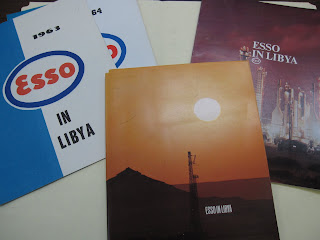
Above: Some of the materials included in the Robert Stine Collection (2011-002).
After a little digging (thanks to Wikipedia and the New York Times online), I discovered that Libya was a kingdom prior to 1969. All of the ESSO materials in this particular collection pertaining to Libya date prior to 1969. Turns out, the Libyan kingdom was pro-Western and friendly with Western countries such as the U.K. and the U.S. According to one of the publications ESSO in Libya 1963:
On 1 September 1969, a small group of military officers led by then 27-year-old army officer Muammar Gaddafi staged a coup d'état against King Idris, launching the Libyan Revolution. After the coup, Gaddafi closed American and British bases and partially nationalized foreign oil and commercial interests in Libya.
An interesting story ...
Turns out, the collection from Robert Stine, long-time patron of the Museum, dealt with the building of the Trans-Alaskan Pipeline in the 1970s AND the ESSO (now EXXON) oil industry in Libya in the 1960s.
Finding materials about the oil industry in Libya? How timely, considering the current events happening. I knew that Libya was an "oil-rich" nation in northern Africa. But I did not know much about its political or economic history.

Above: Some of the materials included in the Robert Stine Collection (2011-002).
After a little digging (thanks to Wikipedia and the New York Times online), I discovered that Libya was a kingdom prior to 1969. All of the ESSO materials in this particular collection pertaining to Libya date prior to 1969. Turns out, the Libyan kingdom was pro-Western and friendly with Western countries such as the U.K. and the U.S. According to one of the publications ESSO in Libya 1963:
"The Libyan Petroleum Law became effective in June 1955 and Esso Libya applied for, and was granted, nine concession areas covering about 100,000 sq.kms. The company then began the painstaking search for oil."
"Esso was the first:
* To discover oil in Libya
* to build a crude oil pipeline to the sea
* to build a marine terminal
* to produce and export oil to foreign markets
* to build a refinery in the country to produce processed oil products for local consumption
* and among the first to agree to the Petroleum Law Amendments of 1961."
On 1 September 1969, a small group of military officers led by then 27-year-old army officer Muammar Gaddafi staged a coup d'état against King Idris, launching the Libyan Revolution. After the coup, Gaddafi closed American and British bases and partially nationalized foreign oil and commercial interests in Libya.
An interesting story ...
Thursday, February 10, 2011
Art & Alzheimer's
I am subscribed to numerous professional email lists, from the regular In the Loop email newsletter from the Society of American Archivists (SAA) to the occassional email blasts from the American Association for State and Local History (AASLH). One subscription that I look forward to perusing is the Dispatches from the Future of Museums, a weekly email blast which consolidates news articles and blog posts about museums and the future.
One of this week's highlighted articles is entitled Art and Alzheimer's at the University of Virginia.
My maternal grandfather had that horrible disease and I'm always interested in learning about it and its treatments. It was hard on my grandmother and the rest of the family as my Papa slowly but steadily drifted into the disease.
I have heard of MoMA's program for Alzheimer's patients and I think it's great that other museums, like the University of Virginia Art Museum, are adopting similar programs. According to the article, several of the patients react positively while participating in the program. I just wonder if those positive strives present themselves outside of the museum setting.
What do you think? Do you think art helps Alzheimer's patients? Would you like to see programs like the ones at MoMA and UVa in an art museum near you?
One of this week's highlighted articles is entitled Art and Alzheimer's at the University of Virginia.
My maternal grandfather had that horrible disease and I'm always interested in learning about it and its treatments. It was hard on my grandmother and the rest of the family as my Papa slowly but steadily drifted into the disease.
I have heard of MoMA's program for Alzheimer's patients and I think it's great that other museums, like the University of Virginia Art Museum, are adopting similar programs. According to the article, several of the patients react positively while participating in the program. I just wonder if those positive strives present themselves outside of the museum setting.
What do you think? Do you think art helps Alzheimer's patients? Would you like to see programs like the ones at MoMA and UVa in an art museum near you?
Friday, February 4, 2011
January Wrap-Up & February Preview
I cannot believe the first month of 2011 has come and gone already! Things have been seemingly low-key at the Museum this month.
One major accomplishment for January: I completed my major project of creating an accession register for the archvies & library donations since 1965. It's nice to know what the Museum actually has! Not only did I create an electronic register (thanks to Excel), I also added most gift/donation information to our collection management database Re:Discovery. With time, and practice, every piece in our collections should be searchable in the database! That will allow us to better serve researchers, visitors and just interested people! Next step? Conducting an inventory to match up actual items (objects, books, manuscripts, etc) with the information. Wish me luck!
Now I can also turn my attention to the Train to Share project I've discussed multiple times here. We are finally ready to start uploading the digital objects and their associated metadata! Hopefully the team will be able to upload our 1000 objects!
Lately, I've also been very busy with researchers and other visitors looking for photographs. In fact, one Friday (typically a quiet day for the Archives Center) I had three appointments and a conference call scheduled. I had to schedule another researcher for the next week because I was so busy! It's great that the Library & Archives Center has had such a demand!
February will be a busy month for the Museum. On the 17th, we'll host our third Family Science Night of the [academic] year: Inventions! Come to the Museum between 6:30 and 8:00 p.m. to learn and explore well-known and not-so-well-known inventions. Lemonade and cookies are provided! Then, a couple of days later, the Museum will host Read-A-Rama on Saturday, the 19th. Come explore the wonderful world of reading and literacy!
One major accomplishment for January: I completed my major project of creating an accession register for the archvies & library donations since 1965. It's nice to know what the Museum actually has! Not only did I create an electronic register (thanks to Excel), I also added most gift/donation information to our collection management database Re:Discovery. With time, and practice, every piece in our collections should be searchable in the database! That will allow us to better serve researchers, visitors and just interested people! Next step? Conducting an inventory to match up actual items (objects, books, manuscripts, etc) with the information. Wish me luck!
Now I can also turn my attention to the Train to Share project I've discussed multiple times here. We are finally ready to start uploading the digital objects and their associated metadata! Hopefully the team will be able to upload our 1000 objects!
Lately, I've also been very busy with researchers and other visitors looking for photographs. In fact, one Friday (typically a quiet day for the Archives Center) I had three appointments and a conference call scheduled. I had to schedule another researcher for the next week because I was so busy! It's great that the Library & Archives Center has had such a demand!
February will be a busy month for the Museum. On the 17th, we'll host our third Family Science Night of the [academic] year: Inventions! Come to the Museum between 6:30 and 8:00 p.m. to learn and explore well-known and not-so-well-known inventions. Lemonade and cookies are provided! Then, a couple of days later, the Museum will host Read-A-Rama on Saturday, the 19th. Come explore the wonderful world of reading and literacy!
Monday, December 13, 2010
Finding the Frame Family
The upcoming holidays and the usual end-of-the-year festivities always remind me of family. Whether you like them or not, your family shapes who you are. Your ancestors contributed to who you are today. And your great-grandchildren will be influenced by the choices you make today.
With this in mind, I turned to the topic of “family” for this post. Upon researching early families in the Permian Basin, I came across the Frame family.
The Museum’s Library & Archives Center has several photographs of members of this family. In fact, some of them grace the Museum’s photograph murals in the North Wing. However, our records for those photographs do not provide much, if any, substantial information about the family; I knew James Milton Frame worked in Odessa and Monahans for the Texas & Pacific Railway in the early twentieth century. And he had several brothers and a father in the area.
With such little information, I turned to the Museum’s Reference Library. With over 2000 published titles, many of which are out of print, the Library holds a wealth of information on Permian Basin county histories. Sure enough, several Odessa and Ector County books held photographs and brief captions on the Frame family. Yet, it was not until I turned to Ward County, 1887-1977, published by the Ward County Historical Commission, that I found more details. Apparently, Paul Frame, James Milton’s son, provided recollections and reflections about his family for the tome’s comprehensive history.
Mr. and Mrs. S. Frame had four sons: James Milton, Walter L., Jesse L., and Charles Albert. One was a newspaper editor, one was an agent for the Texas & Pacific Railway, and two were telegraph operators. I’m sure Father Frame never realized the parts his sons would play in the shaping of the Permian Basin!
An expert telegrapher, Walter L. Frame or “Sport” came to West Texas from Kimbolton, Ohio, in 1888 to work as a night telegrapher for the Texas & Pacific Railway. “Sport” brought his brother James Milton to Monahans in 1889 and taught him telegraphy.
James Milton, in turn, worked as a telegraph operator in Midland for several years in the 1890s. (He worked in numerous places, including Metz, Allamore, Odessa, and Pecos, over his twenty-seven years with the Texas & Pacific Railway.) While in Metz, James met Catherine Andrews and they married in Midland in 1895. By 1896, he was the depot agent as well as the postmaster in Monahans. As postmaster, he devised a progressive method to sort the mail: he used “pigeon holes” for the patrons’ mail and could lock the whole thing while away. Together, James and Catherine had three children, daughter Thelma (born 1897), son Paul (born 1900) and son James Eugene (born 1903). After working for the Texas & Pacific, James Milton Frame worked an additional twenty-one years for the El Paso and Southwestern Railway, eventually retiring in 1938 to Ruidoso, New Mexico.
Jesse L. Frame was the newspaper man. In 1906, he helped J. H. Rotramel launch the Ector County Democrat. They were assisted by Charles Judkins and Miss Gertie Rabb. Miss Annie Mae Harkey set type by hand for the paper. Jesse owned and operated the newspaper until 1911.
Charles Albert, the fourth brother, was a long-time telegraph operator in Odessa and in Monahans. Charles married Georgia Hogg from Odessa. He was also elected to the first City Council as an alderman for Monahans in 1928. He passed away in 1960 at the age of 77.


If any information is incorrect or if you have additional information, please contact me by leaving a comment!
With this in mind, I turned to the topic of “family” for this post. Upon researching early families in the Permian Basin, I came across the Frame family.
The Museum’s Library & Archives Center has several photographs of members of this family. In fact, some of them grace the Museum’s photograph murals in the North Wing. However, our records for those photographs do not provide much, if any, substantial information about the family; I knew James Milton Frame worked in Odessa and Monahans for the Texas & Pacific Railway in the early twentieth century. And he had several brothers and a father in the area.
With such little information, I turned to the Museum’s Reference Library. With over 2000 published titles, many of which are out of print, the Library holds a wealth of information on Permian Basin county histories. Sure enough, several Odessa and Ector County books held photographs and brief captions on the Frame family. Yet, it was not until I turned to Ward County, 1887-1977, published by the Ward County Historical Commission, that I found more details. Apparently, Paul Frame, James Milton’s son, provided recollections and reflections about his family for the tome’s comprehensive history.
Mr. and Mrs. S. Frame had four sons: James Milton, Walter L., Jesse L., and Charles Albert. One was a newspaper editor, one was an agent for the Texas & Pacific Railway, and two were telegraph operators. I’m sure Father Frame never realized the parts his sons would play in the shaping of the Permian Basin!
An expert telegrapher, Walter L. Frame or “Sport” came to West Texas from Kimbolton, Ohio, in 1888 to work as a night telegrapher for the Texas & Pacific Railway. “Sport” brought his brother James Milton to Monahans in 1889 and taught him telegraphy.
James Milton, in turn, worked as a telegraph operator in Midland for several years in the 1890s. (He worked in numerous places, including Metz, Allamore, Odessa, and Pecos, over his twenty-seven years with the Texas & Pacific Railway.) While in Metz, James met Catherine Andrews and they married in Midland in 1895. By 1896, he was the depot agent as well as the postmaster in Monahans. As postmaster, he devised a progressive method to sort the mail: he used “pigeon holes” for the patrons’ mail and could lock the whole thing while away. Together, James and Catherine had three children, daughter Thelma (born 1897), son Paul (born 1900) and son James Eugene (born 1903). After working for the Texas & Pacific, James Milton Frame worked an additional twenty-one years for the El Paso and Southwestern Railway, eventually retiring in 1938 to Ruidoso, New Mexico.
Jesse L. Frame was the newspaper man. In 1906, he helped J. H. Rotramel launch the Ector County Democrat. They were assisted by Charles Judkins and Miss Gertie Rabb. Miss Annie Mae Harkey set type by hand for the paper. Jesse owned and operated the newspaper until 1911.
Charles Albert, the fourth brother, was a long-time telegraph operator in Odessa and in Monahans. Charles married Georgia Hogg from Odessa. He was also elected to the first City Council as an alderman for Monahans in 1928. He passed away in 1960 at the age of 77.

James (sitting) and Walter Frame, circa 1890. At the time of this photograph, James was the night telegraph operator for the Texas & Pacific Railway in Midland, Texas. (From the Paul Frame Collection, 84-016.008.)

Old Section House in Metz, Texas, circa 1893. James and Walter Frame stand on the gallery. By this time, James was the station agent in Metz. (From the Betty Orbeck Collection, 76-094.055)

Interior of the Ector County Democrat office, circa 1906. Jesse L. Frame (standing on the left) owned and edited the paper until 1911. (From the Betty Orbeck Collection, 76-094.060)

Charles, Jesse and James M. Frame at the Monahans Texas & Pacific Railway Depot, circa 1909. Jesse sits on a copy press in the center with Charles to the left and James to the right. By this time, James was the station agent. (From the Paul Frame Collection, 84-016.014)

Interior of James M. Frame’s home in Monahans, Texas, circa 1910. (From the Betty Orbeck Collection, 76-094.153)

Interior of Monahans Texas & Pacific Railway Depot, circa 1910. Standing left to right: James M. Frame, agent; Pink Mitchell, rancher; Cleve Brown; Theo Andrews, roadmaster (at telephone). Sitting left to right: Charles Frame, 2nd trip operator, and S. Frame, father of James M. and Charles. (From the Abell-Hanger Foundation Collection, 76-093.470)
If any information is incorrect or if you have additional information, please contact me by leaving a comment!
Subscribe to:
Posts (Atom)